Posts

Showing posts with the label Germany

Discovering Weissenfels: Nine Things to See When Visiting

Image
* This post is part of a paid partnership with the cities of Weissenfels, Merseburg and Zeitz. * Weissenfels, deep in the heart of Saxony-Anhalt, is a city full of contradictions. Old vs. new, fallen into ruins vs. beautifully restored. All of this is represented most in the castle towering high above in the town south-west of Leipzig: Schloss Neu-Augustusburg . While half of it, at least from the exterior, shines in new splendour, the other half is falling into ruins. It is a fascinating contrast you will find all over this historically rich little town. Once the residence of the Duchy of Saxe-Weissenfels, it later became the number one shoe-manufacturing city of the German Democratic Republic. As so many places, the aftermath of unification left a lasting mark on Weissenfels with many especially young people moving away to find work elsewhere, and houses left empty. But you will find as many rays of hope here, so let's delve deeper into the things not to miss when visiting Weisse...

Between Ravens and Charms: Nine Places to Visit in Merseburg

Image
* This post is part of a paid partnership with the cities of Weissenfels, Merseburg and Zeitz. * Have you heard of Merseburg? This medieval German town is situated on the banks of the river Saale approximately 30 kilometres west of Leipzig. It boasts a great historical significance. Firstly mentioned in 850, it became the seat of the Bishop of Merseburg in 968 and remained so until the Reformation. During the Early and High Middle Ages, the town once was the most important Kaiserpfalz , roughly translated as imperial residence, in the East of the Holy Roman Empire for the ever-travelling ruler. While its importance somewhat faded when the modern age rolled around, it once again became the home of a ruler between 1657 to 1738 when Merseburg was the residence of the Dukes of Saxe-Merseburg, a secundogeniture of the Albertine line of the House of Wettin. Sounds interesting? Here are nine recommendations what to do and see when visiting Merseburg. Start at Schloss Merseburg , of c...

Schloss Moritzburg and Beyond: How to Spend a Day in Zeitz

Image
* This post is part of a paid partnership with the cities of Weissenfels, Merseburg and Zeitz. * Do you know those "It's on my list"-places? Towns or places where you have been wanting to visit for a while but haven’t gotten around to?! Recently I scratched one of those places off my imaginary list: Zeitz . Once upon a couple of centuries ago - between 1656 and 1718 to be precise - this little town was the capital of a small German state and secundogeniture of the Albertine line of the House of Wettin, the Duchy of Saxe-Zeitz. As any self-respecting residential town Zeitz, of course, boasts a palace: Schloss Moritzburg (not to be confused with the probably more famous Schloss Moritzburg near Dresden ). But let's not get ahead of ourselves and start my visit in chronological order. After arriving in Zeitz, I started my tour of discovery of the town in the old market square , known as Altmarkt in German. Zeitz's history actually goes back to the Middle Ages. Firs...

Schloss Paretz and Schloss Caputh: The Unknown Prussian Palaces

Image
We have covered plenty of Prussian palaces here on Confessions of a Castleholic , we even have a post on how many Prussian palaces you can see in a day. ( It's five, in case you wondered. ) But today, we are going to have a look at two pretty unknown palaces of the Hohenzollern family that once ruled as German Emperors: Schloss Paretz and Schloss Caputh . Never heard of them? Don't worry, neither had I before I moved to Berlin and got myself an annual ticket to the Prussian palaces surrounding the German capital. The fact that we know fairly little about them probably has as much to do with their location as well as their less ornate decoration. Schloss Caputh "Less ornate?", you may ask. "But that's a Baroque palace!" And right you are. But as it is an early example of Baroque architecture in this region,  Schloss Caputh  may not compare to the more lavishly decorated Rococo palaces of nearby Park Sanssouci in many peoples eyes. The palace located on ...

Kloster Neuzelle: Brandenburg’s Baroque Beauty

Image
A Baroque church in Brandenburg? Yes, that exists! Admittedly, the northern half of Germany isn't naturally blessed with a lot of beautiful Baroque churches. While there are plentiful in the southern Catholic half of the country, northern Germany is the heart of famously frugal and restraint Lutheran protestantism. So Kloster Neuzelle is quite the exception, a Baroque treasure on the German-Polish border hidden among a plethora of (Neo-)Gothic churches. Neuzelle Abbey was founded as "Nova Cella" in 1268 by Heinrich the Illustrious, Margrave of Meissen and Lusatia. The aim was to Christianise the recently conquered surrounding Sorbian lands. The first Abbey was built between 1300 and 1330 in typical local Gothic brick style. During the 15th century, it was repeatedly destroyed by the Hussites. As the monks refused to convert to the teachings of Jan Hus, they were banished or killed. Despite, Neuzelle Abbey survived the reformation as the only Catholic monastery in all of ...

Three at One Stroke: Dornburger Schlösser

Image
Why go to one castle if you can have three? The castles and palaces of Dornburg, all located within a few hundred metres, tower high above the Saale River in the German state of Thuringia offer exactly that possibility. All three of them were built during different periods of time and aren't actually the first castles to be located on this site. But instead of starting chronologically, let's first have a look at the newest and prettiest - yes, I'm shallow like that - of them all: the Rococo-Schloss . As the name suggests, the original Rococo-Schloss was built during the 18th century. In 1732, Duke Ernst August of Saxe-Weimar-Eisenach commissioned architects to build him a palace in Dornburg. The occasion? A planned military parade. (I guess you can only end up eccentric when you take August the Strong as your inspiration.) However, something must have gone wrong at the time. Soon after it was finished, the palace was demolished due to construction defects. But we are looki...

A Rococo Dream Come True: Schloss Wilhelmsthal

Image
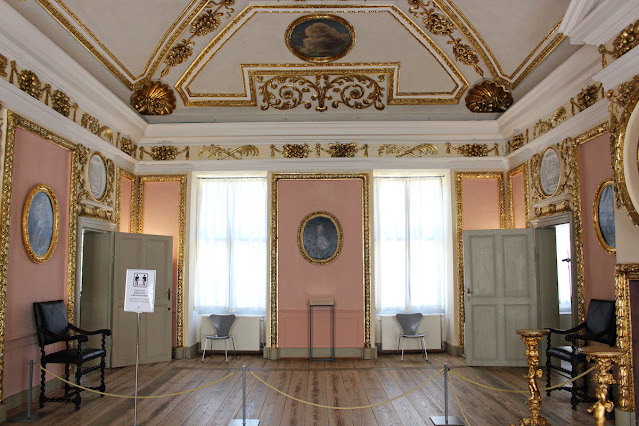
This is basically a live edition of Confessions of a Castleholic , I don't think I have ever shared a palace on here so quickly after visiting. But I fell in love - and I wanted to share that love. If you follow me on Instagram (note: you should as not to miss all the latest castle adventures ), you already know that I paid a visit to Schloss Wilhelmsthal near Kassel over the weekend. And it is a stunning Rococo dream come true! Long time followers of this blog may recall me visiting Schloss Wilhelmshöhe once upon nearly a decade ago. Schloss Wilhelmsthal - Höhe literally means "hill" while Thal is "valley" - is only a stone's throw away but somehow I never knew about it. Probably that's what keeps me castle hunting for more than decade now: There's still so much more to discover yet. Schloss Wilhelmsthal , now a museum, was once owned by the Landgraves of Hesse-Kassel. The surrounding estate was purchased by Landgravine Amalie Elisabeth, widow ...

East of Berlin: Six Castles to See on a Day Trip from the German Capital

Image
Historically speaking, Berlin wasn't your prime European metropolis along the lines of Paris or London for many centuries. A frugal backwater somewhere in the north of the German-speaking nations, it only gained prominence during the mid-18th and 19th century. After the unification of Germany in 1871, Berlin became the new capital of the Prussian dominated German Empire. It was also the time of the industrialisation of Germany and so around the same time, a lot of noble homes started to spring up all around Berlin. Today, I'm taking you to six of those in the Oder-Spree administrative district east of Berlin. All of them can be easily reached on a day out from the German capital. The star of the show of today's post undoubtedly is Schloss Neuhardenberg . The originally Baroque palace was redesigned in the Neo-Classical style for Chancellor Karl August Prince of Hardenberg by no other than Prussia's most famous architect Karl Friedrich Schinkel. The Schloss had been gif...