Posts

Showing posts with the label Spain

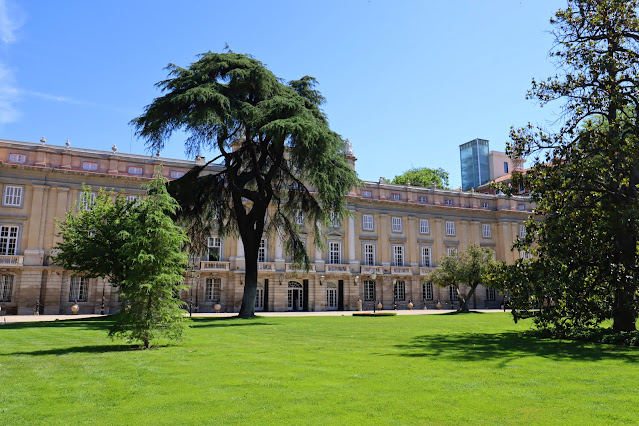
Beyond Royal Splendour: Three Noble Palaces to Discover in Madrid
Image
You have been to Madrid a couple of times and have seen all the royal palaces or simply like to venture off the beaten track and avoid the crowds? In today's post we have got you covered in both cases as we have a look at not one but three nobles palaces in the Spanish capital to discover. Palacio di Liria The Palacio di Liria is the only one of today's palaces still owned by a noble family, and one of Spain's most important noble families at that: the Dukes of Alba. Legends has it that they are so wealthy they can walk from the north of Spain to the south without taking a step off their own property. Whether that’s true or not, their Madrid residence - built between 1767 and 1785 on the orders of the third Duke of Berwick and Liria, Jacobo Fitz-James Stuart y Colón, whose descendants also became Dukes of Alba - sure is a sight to behold. The Palacio di Liria was designed by Ventura Rodríguez in Neo-Classical style. Sadly, all but the facades were destroyed by fire during...

Royal Chapel of Granada

Image
Two of the most famous rulers of Spain's history are the Catholic Monarchs: Queen Isabel I of Castile and King Fernando III of Aragon. Their union essentially created Spain in the first place by uniting the crowns of Castile and Aragon. The title of "Catholic King and Queen" was bestowed on them by Pope Alexander VI in 1494, in recognition of their defence of the Catholic faith within their realms. During their reign, the fall of the last Islamic state in Iberia, the Emirate of Granada, took place in 1492 thus ending the Reconquista. The royal couple decided a few years later, in 1504 to be precise, that they wanted to be be buried in Granada after their deaths. They chose to be buried in Granada because they saw its conquest as the crowning achievement of their reign. For this reason, they built the Royal Chapel, which was constructed between 1505 and 1517. The Capilla Real of Granada adjoins the city's Cathedral of the Incarnation and was built in Isabellin...

Real Sitio de San Lorenzo de El Escorial

Image
Real Sitio de San Lorenzo de El Escorial - what a name! Located northwest of Madrid, the Royal Sight has functioned as a monastery, basilica, royal palace, pantheon, library, museum, university and hospital over the years. And believe me, no picture does it justice just how massive this place is. In fact, El Escorial is nothing less than the world's largest Renaissance building featuring one of the most beautiful libraries I have ever laid eyes on though unfortunately you aren't allowed to take pictures inside the complex. When King Felipe II of Spain took home victory in the Battle of St. Quentin in Picardy against King Henri II of France on the Feast of Saint Lawrence in 1557, he swore to erect a monument dedicated to the saint. The King's astrologers chose the small village of El Escorial in the hills near Madrid as the perfect location. The works began on April 23, 1563 and lasted for more than 20 years. Felipe II appointed the Spanish architect Juan Bautista ...

Alhambra de Granada

Image
Alhambra - the name alone let's you think of a thousand and one nights, splendorous architecture and the magical palaces. Nestled on the foot of the snowy Sierra Nevada mountains in southern Spain, it was here that the Nasrid dynasty wrote the last chapter of the history of the Muslim rule over the Iberian peninsula. In 1492, Granada was the last of the Moorish kingdoms captured by Christian forces thus ending 700 years of influence over the region. Literally the red castle (Al-Hamra) due to the colour of its walls, the Alhambra is located on a hill above the city of Granada. Its history dates back to the 9th century when a small fortress by the name of Ma’qil Ilbira built on the ruins of a Roman fortress was located on the site. While the castle was expanded, Granada was still a historical backdrop at the time. This changed when Muhammad ibn Yusuf ibn Nasr, the founder of the Nasrid dynasty, was forced to flee from Jaén to avoid persecution by King Ferdinand III ...

Real Alcázar de Sevilla

Image
You don't really notice the vibrant beauty of the Royal Alcázar of Seville when you first walk up to it. Thick walls and high towers guard the splendours of this royal palace complex dating back to the days of the Muslim rule over the Iberian peninsula, though most of its beautiful rooms were actually built - by Moorish workmen - for the Christian King, Pedro the Cruel of Castile, in the 1360's. Still, the style of the palace is heavily influenced by the Muslim rule of Spain that lasted from the conquest in 711 until 1492, when Granada was recaptured by Christian forces. The word Alcázar actually comes from the Arabic word for castle, al-qasr. And that's what it is. An extensive castle complex including some stunning gardens that actually double as the Water Gardens of Dorne in Game of Thrones. The Real Alcázar  still houses the official residence of the King of Spain whenever he visits Seville thus making it the oldest royal residence in Europe in use. While use ...