Posts

Showing posts with the label Potsdam

Schloss Paretz and Schloss Caputh: The Unknown Prussian Palaces
Image
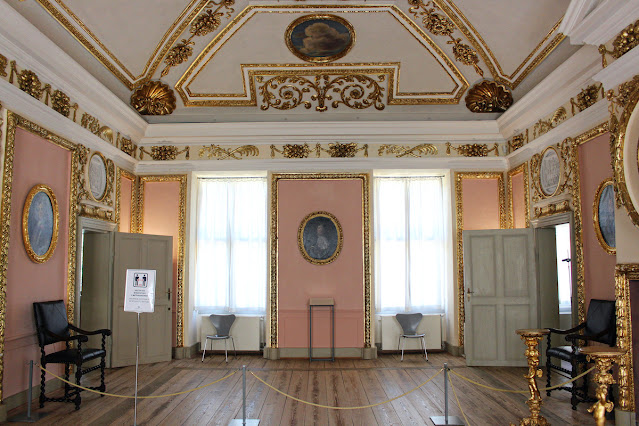
We have covered plenty of Prussian palaces here on Confessions of a Castleholic , we even have a post on how many Prussian palaces you can see in a day. ( It's five, in case you wondered. ) But today, we are going to have a look at two pretty unknown palaces of the Hohenzollern family that once ruled as German Emperors: Schloss Paretz and Schloss Caputh . Never heard of them? Don't worry, neither had I before I moved to Berlin and got myself an annual ticket to the Prussian palaces surrounding the German capital. The fact that we know fairly little about them probably has as much to do with their location as well as their less ornate decoration. Schloss Caputh "Less ornate?", you may ask. "But that's a Baroque palace!" And right you are. But as it is an early example of Baroque architecture in this region,  Schloss Caputh  may not compare to the more lavishly decorated Rococo palaces of nearby Park Sanssouci in many peoples eyes. The palace located on ...
From Prussia with Love: Visiting Five Potsdam Palaces in One Day

Image
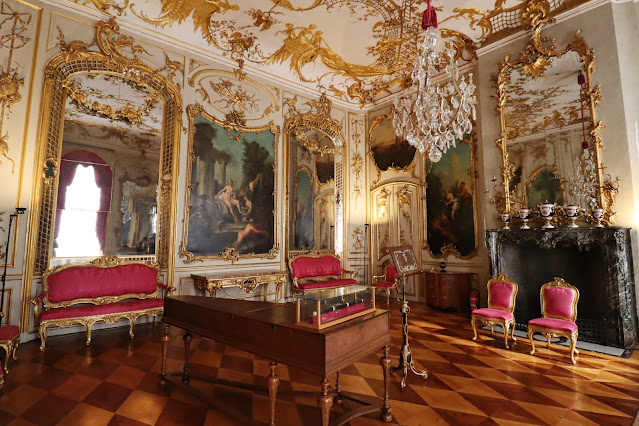
So just how many castles and palaces can you visit in a day? Of course that depends on lots of things, especially whether the places you visit are open or closed to the public. Probably my record for castles actually open to visitors is five. Where I achieved this feat? In Potsdam, a preferred residence of the Prussian kings and the German Kaiser until 1918 just outside of Berlin. And while I managed to squeeze in five in a day, you could actually visit about three times as many palaces if you like in Potsdam. Pro tip of the day: Get yourself a  sanssouci+ ticket that allows entrance to all of the plentiful palaces of Potsdam in a day. With it, you book a fixed admission time slot for viewing Schloss Sanssouci . To be able to better plan the day, I chose mine for shortly after 10am. The private summer residence of King Friedrich the Great of Prussia is always the most crowded of places in Potsdam. While it certainly is one of the most famous palaces in all of Germany, it is ac...

Schloss Lindstedt

Image
Just a stone's throw away from the Neues Palais and the adjoining Park Sanssouci yet far off the beaten tourist tracks lies perhaps the least known of Potsdam's plentiful palaces . Frankly, yours truly had never heard of it before the recently publicised Hohenzollern restitution debate . But you know me, once I hear of a palace in my vicinity, there is hardly any stopping this Castleholic. Today an event location, you can stroll around its park any (day) time.  It was in 1828 that King Friedrich Wilhelm III of Prussia purchased a small country estate mainly used for carp breeding from the noble Bülow family. His oldest son and successor, the future Friedrich Wilhelm IV, took an immediate interest in the estate. For decades following the purchase, the Crown Prince and later King drew up over 100 plans to reshape a Baroque building located on the estate into a small but magnificent palace in Neo-Classical style. Architects commissioned to submit plans for the new structu...

Chinese House, Potsdam

Image
Do you remember that I was struggling to calculate the number of castles I visited in 2018 due to various reasons including a fancy garden house? Well, here it is! And was I right or was I right?! The Chinese House, also sometimes called Chinese Tea House, is a garden pavilion in Sanssouci Park in Potsdam not far from the palace of the same name  and a fancy one it is.  The Chinese House owes its existence to King Friedrich II of Prussia, famously known as 'the Great'. The King commissioned Johann Gottfried Büring to design an ornamental garden house to adorn his gardens about 700 metres southwest of Schloss Sanssouci . For his designs Büring borrowed ideas from the Rococo architecture favoured by the King and took inspiration from Chinese architecture. Chinoiserie, a European interpretation and imitation of Chinese and East Asian artistic traditions, was popular at the time. The Chinesisches Haus was modelled after the Le Tréfle garden   pavilion in t...

Orangerieschloss

Image
Rounding off our series of posts on the plentiful palaces of Potsdam - because I will need to do some more castlehunting before when can delve deeper into the other handful of Prussian palaces in the capital of the German state of Brandenburg - is the Orangerieschloss , also known as the Orangery Palace. The palace owes its existence to King Friedrich Wilhelm IV and was originally planned to be part of a larger ensemble. Friedrich Wilhelm, known as "the Romantic on the Throne", wished for a triumphal road imitating a Roman via triumphalis leading some two kilometres through Potsdam. He intended to incorporate several already existing buildings as well as temples, palaces and viaducts. Already during his time as Crown Prince, Friedrich Wilhelm studied the Renaissance style and later travelled to Italy drawing inspirations from both. However, because of the political unrest of the period and lack of funding, the project was never fully carried out. The Orangerieschlos...

Neues Palais (Potsdam)

Image
The Neues Palais , or New Palace, in Potsdam may neither be the most famous nor the most beautiful of the city's plentiful palaces , yet there is something incredibly fascinating about the place for it seems the one where it is easiest to meet history. If the walls of the palace originally built by Friedrich the Great could talk, they would have quite a story to tell. All that culminates in one of the first rooms you get to see when visiting the palace: Worn-out wall coverings, old masters, missing paintings, a graffiti by Soviet soldiers, a contrasting red Baroque chair - there are few places where you can get so close to the changing history of Germany. Like so many of Potsdam's palaces, the Neues Palais owes its existence to King Friedrich II of Prussia, better known as 'the Great'. In difference to his other palaces, Friedrich never intended to use the New Palace as a residence for himself but instead as a place to stay for his guests. While one of the last...