Posts

Showing posts with the label CastleTalk

The (In)Famous Sayn-Wittgenstein-Berleburg Will, Round 3: When There Is An Estate Worth Half a Billion Up For Grabs, That's Apparently Where Cordial Family Relations End
Image
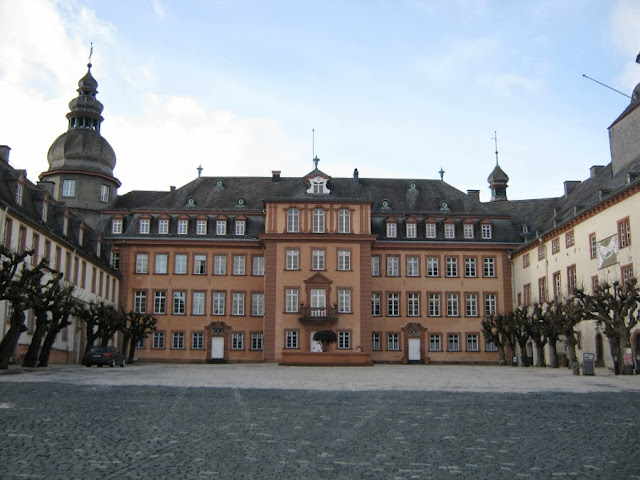
Schloss Berleburg , the main residence of the Sayn-Wittgenstein-Berleburg family ...at least here on Confessions of a Castleholic , I'm sure it has been more rounds for the family. Just the other week I said over on Twitter that deposed royal families without their family disputes would only be half the fun - and one of the most intriguing family disputes within the German nobility has reared is ugly head again as of late: The inheritance dispute within the Sayn-Wittgenstein-Berleburg family. It is based on a will that was drawn up during the days of the Third Reich and includes some, well, racist, to say the least, stipulations. Yours truly still has a hard time to understand that someone would actually try to enforce those... Then again, there is an estate said to be worth about a half of a billion euros up for grabs - and that's probably where most friendships (or cordial family relations) end. (To catch up: What is this will? What is the dispute about? ) To ...

Between #Megxit and #Harryverderci: The Reality of Royalty or Life In a Goldfish Bowl

The reality of royalty isn’t all fun and games and ball gowns and tiaras, as much as we like to think that. The announcement of the Duke and Duchess of Sussex to step down as senior royals has sent shockwaves around the world. Some applaud their decision while others are skeptical about how it will work. Count me among the latter group. Many, including yours truly, couldn’t shake the feeling over the past couple of months that royal life simply wasn’t the life for Harry and Meghan. Royal life, especially within the British royal family, is life in a goldfish bowl. Every move, every smile, every seemingly unhappy face will make a headline. With online and social media, the magnifying glass on that goldfish bowl has grown only larger and larger. In short: It’s not a life to envy. Harry and especially Meghan were the latest addition to that goldfish bowl and the most shiny and sparkly one at that. He, the longtime bad boy prince charming, and she, the mixed-race American actress. As...

The "Wittelsbacher Ausgleichsfonds" or How the Bavarians Probably Got the Best Deal When the Monarchy Ended

Image
The Great Hall of Schloss Nymphenburg They came to power during the 12th century in the days of Holy Roman Emperor Friedrich I Barbarossa - and on November 7, 1918, their head of the family was the first German King forced to abdicate. But in the end, the former Royal Family of Bavaria may just have gotten the best deals of all the formerly reigning families in Germany. You see, the German nobility is full of curious inheritance cases like the Sayn-Wittgenstein-Berleburg's or the Thurn und Taxis' . In addition to these internal family matters, there are also some interesting constructions between former German reigning family and the German state - or one of its federal states. Case in point: The  Wittelsbacher Ausgleichsfonds . It was established as a public foundation in 1923 within the framework of the apportionment of assets and liabilities between the Free State of Bavaria and their former royal family, the Wittelsbachs. Five years prior, in 1918, the monarchi...

The Stuff Legends Are Made Of: The Mystery of the Amber Room

Image
Few castles ever become legendary in themselves: Versailles, Neuschwanstein, maybe a handful more. Probably even fewer rooms of a castle share the same status and when German Baroque sculptor and architect Andreas Schlüter was commissioned to design a room made of amber for Schloss Charlottenburg in 1701, nobody knew what a legend it would become. Constructed by Gottfried Wolfram, master craftsman to the Danish court of King Frederik IV of Denmark, with the help of amber masters Ernst Schacht and Gottfried Turau from Danzig, the room wasn't even installed at its originally intended place but instead at the Stadtschloss in Berlin. It was at the city palace where Tsar Peter the Great first lay eyes on the creation and liked it. Eager to please, King Friedrich Wilhelm I of Prussia, gifted the room to his Russian counterpart. In return, he got a Russo-Prussian alliance against Sweden as well as a bunch of really tall guys, yes literally, for his army. Pretty good deal, e...

Twists and Turns of History: The Many Dimensions of the Hohenzollern Claim to Their Former Properties

Image
Schloss Sanssouci is perhaps the best known of all Prussian palaces, it is not part of the current restitution claims The Hohenzollern, the heirs of the German Kaiser and King of Prussia, have made more headlines over the past couple of months than usual. Why? They have filed different lawsuit to reclaim former properties. One of the court cases, about Schloss Rheinfels in St. Goar along the most scenic part of the Rhine river in Western Germany, has been dismissed this summer . For a couple of years now and behind closed doors, there have also been negotiations between the Prussian branch of the Hohenzollern family, the federal government of Germany and the states of Berlin and Brandenburg  in Eastern Germany concerning the restitution of tens of thousands of art objects, unpaid housing rights at Schloss Cecilienhof or two other residences in Potsdam, and compensation payments for expropriations following the Second World War. Due to the demands of the family that were de...

The Last In Line: When Royal Families Sell Their Castles

Image
Schloss Marienburg (top left), Schloss Erbach (bottom left) and Kloster Bronnbach Imagine you could trace back your family's history hundreds and hundreds of years. They were counts, dukes, kings, ruled the people and amassed a fortune - or at least dutifully served thus who did. Now most of what is left is a big pile of stones, also known as castles. But you neither rule the people (and could thus raise taxes) nor have a fortune left. What to do with that castle? If you are a minor noble from a little known family, all you can do is to hustle and bustle and hope for the best, try to find someone who wants to buy it or ultimately let your castle fall into ruins. If your ancestors were well-known and actually ruled the region, chances are that the castle is of historical and cultural importance and thus the state may be willing to take if off your hands. Today, let's have a look at several examples of that in Germany. Schloss Marienburg , of course, is still on everybo...

Royals Gone Vogue: Treading the Line Between Divine Rights and Celebrity Culture

Image
These days royal and celebrity cultures are linked closer together then ever before. Royal fashion and style are a favourite pastime of many - and some royals have (rightly or wrongly) been described as style icons. (A term used inflationary in today's world, I might add.) Royals are featured on the covers of Vogue, Tatler and other glossy magazines or show their life on social media. The immortal Sisi , Marie-Antoinette, Diana and a few more - of course there have always been royals who had the IT factor. Yet both worlds have edged ever closer over the 20th century and have never been as closely linked as they are in today's age. But when are royals treading just too closely with the glitz and glam world of the stars and celebrities who are famous for being famous? Let's face it, monarchy is a pretty outdated concept. In a day and age when largely anything goes, it's neither new nor original that someone based on the luck of birth becomes the head of a nation. ...

What The Heck? The One In Which I Criticise Meghan And Kate (Because I Can)

Image
Photo: Wikimedia Commons/Mark Jones The Duchesses of Cambridge and Sussex really bring out the worst in people, don't they? Not Meghan and Kate themselves but their very existence. The royal watching world has become an interesting one, to say the least, since Meghan joined the scene. Because, let's face it, there can never be two women peacefully coexisting. It's a truth universally acknowledged that one woman must always be pitted against another. And to join the fun: I will criticise them too. Because I can and I will, just wait for it... (I'm currently still working on my critcism because I'm honestly just not that interested in the British royal family to begin with apart from that period when I was about 13 before I discovered the bad boys from Monaco who were way cuter back then. And still kind of are, at least one of them.)  There have always been different camps in royal watching: Elizabeth vs. Margaret, Mary vs. Letizia, Diana vs. Fergie, and you...

Haute Couture vs. High Street: The Back-Story of the Rania Drama

Image
Photo: Netty Have you heard? It's been a tumultuous year thus far in royal watching: Queen Rania of Jordan, ever the fashion icon, released a statement about the estimated cost of her clothing by UFO No More being untrue. "In view of their assessments that is far from reality and truth, we have asked their sponsors not to include Her Majesty in the annual reports of their blog", the Hashemite Royal Court stated saying that "some may deplore the fact that a person of Her Majesty’s status accepts the principle of 'borrowing', but we do not advertise or promote fashion on any of Her Majesty’s pages on social networking platforms, unless the designs are Jordanian." So in short: The Jordanian court claims that while Queen Rania may be wearing very expensive clothes, she isn't actually paying for them. A lot has been said about the incident in the past couple of days. Both Netty and Sophie , among others, have given interesting views on the mat...

Rebuilding Destroyed Castles: New Purposes for Old Buildings

Image
Under construction: The City Palace in Berlin We have covered hundreds and hundreds of castles here on Castleholic , most of them in Germany. With their history even more diverse than their architecture, there is, however, one decisive time period that comes up in almost any castle's history: World War II and its consequences for the (former) royal or noble residences. Especially the urban palaces and castles suffered heavily during the days of the war, be it air raids or shelling towards the end of the war. While many palaces were heavily damaged and later rebuilt, others were razed to the ground to make room for more functional buildings, car parks or something more suitable with post-war life in Germany.  However, the 21st first century has seen the resurrection of a number of palaces leveled to the ground in the years and decades after the war after initial damage, be it the city residences of Potsdam, Brunswick and Berlin or the Baroque palace of Herrenhausen in Han...

A Royal Celebration: The Origins of the Oktoberfest

Image
Horse racing at the Oktoberfest (ca. 1823 by Heinrich Adam) When the average person thinks of a "German", they probably think of a beer-loving and sausage-eating individual dressed in Dirndls and Lederhosen . The reason for this stereotype? Probably the Oktoberfest , the world's largest beer festival and funfair taking place in Munich - and here's the unexpected twist - from mid-September to the first weekend of October every year. But did you know that the Wiesn , as they are also known in Germany, boast a very royal origin? In 1810, Crown Prince Ludwig of Bavaria, the future King Ludwig I (grandfather of the much more famous Ludwig II), married Princess Therese of Saxe-Hildburghausen. Surrounding their wedding on October 12, there were several public and private celebrations held over five days. On one of the last days of the celebrations, the citizens of Munich, the Bavarian capital, were invited to attend festivities held on the fields in front of the ...

Reflections of a Castleholic: How Many Castles Are Too Many?

Image
The castle adventure I almost forgot: Salzburg The other day I was trying to come up with a list of castles and palaces I visited this year already. Writing down the names of almost thirty, I realised I wasn't sure I could remember them all and if I was missing any. After putting the list away, I noticed after a few minutes that I was indeed missing at least one castle, the last one I visited actually. It made me think: How many castles are too many? The last few years have been a whirlwind of castle hunting - and I am truly enjoying the ride. While Castleholic isn't the reason I visit castles, I think it has spurred my interest because I do want to regularly update the site. In 2016, I visited 19 castles and palaces ; in 2017, it was 28 . And while I could have sworn that I saw way more castles last year, I have actually already surpassed that mark this year - 29 castles and counting as of late August. Many - though not all - of my holidays include some castle-seein...

Don't Forget The Spud: Why People Put Potatoes on the Grave of Friedrich the Great

Image
King Friedrich II of Prussia is famous for many things: His victories on the battlefield that made Prussia one of the leading European powers, his support of the arts, his endorsement of the Enlightenment - and for bringing the potato to Prussia and thus to Germany. While it's hardly imaginable today considering the Germans' love for all things potato, his subjects initially weren't too happy about this strange and exotic plant coming from South America. Friedrich the Great, locally also known as Old Fritz, introduced the potato to the Kingdom of Prussia in 1743. All throughout the 18th century, famines had ravaged Europe and led to the starvation of thousands of people. Friedrich recognised the affordable and nourishing qualities of the new vegetable previously only thought to be fit to feed animals. However, his people weren't having it. Despite royal orders, the Prussian people were reluctant to grow and eat potatoes.  But Old Fritz had a plan: First, he ...

New Developments: The (In)Famous Sayn-Wittgenstein-Berleburg Will Continued

Image
New developments in the case of the (in)famous Sayn-Wittgenstein-Berleburg will . A local newspaper reports that, after the death of Prince Richard of Sayn-Wittgenstein-Berleburg who died last year, there is a family dispute over the inheritance within the family. Schloss Berleburg To recap: In 1943, Fürst Gustav Albrecht of Sayn-Wittgenstein-Berleburg drew up a will for his inheritance. While the exact contents of the will are not known publicly, it is common knowledge that the will includes a stipulation that his heir needs to marry a woman, who is a "Protestant", "aryan" and "noble". Prince Gustav Albrecht, who was the father of the aforementioned Prince Richard, went missing in action in June 1944 while serving as a Nazi officer on a campaign in the Soviet Union. He was declared dead in 1969. It has long been assumed that his will passed over his own son, Richard, in favour of Richard's male heirs to save inheritance taxes. Richard's ...